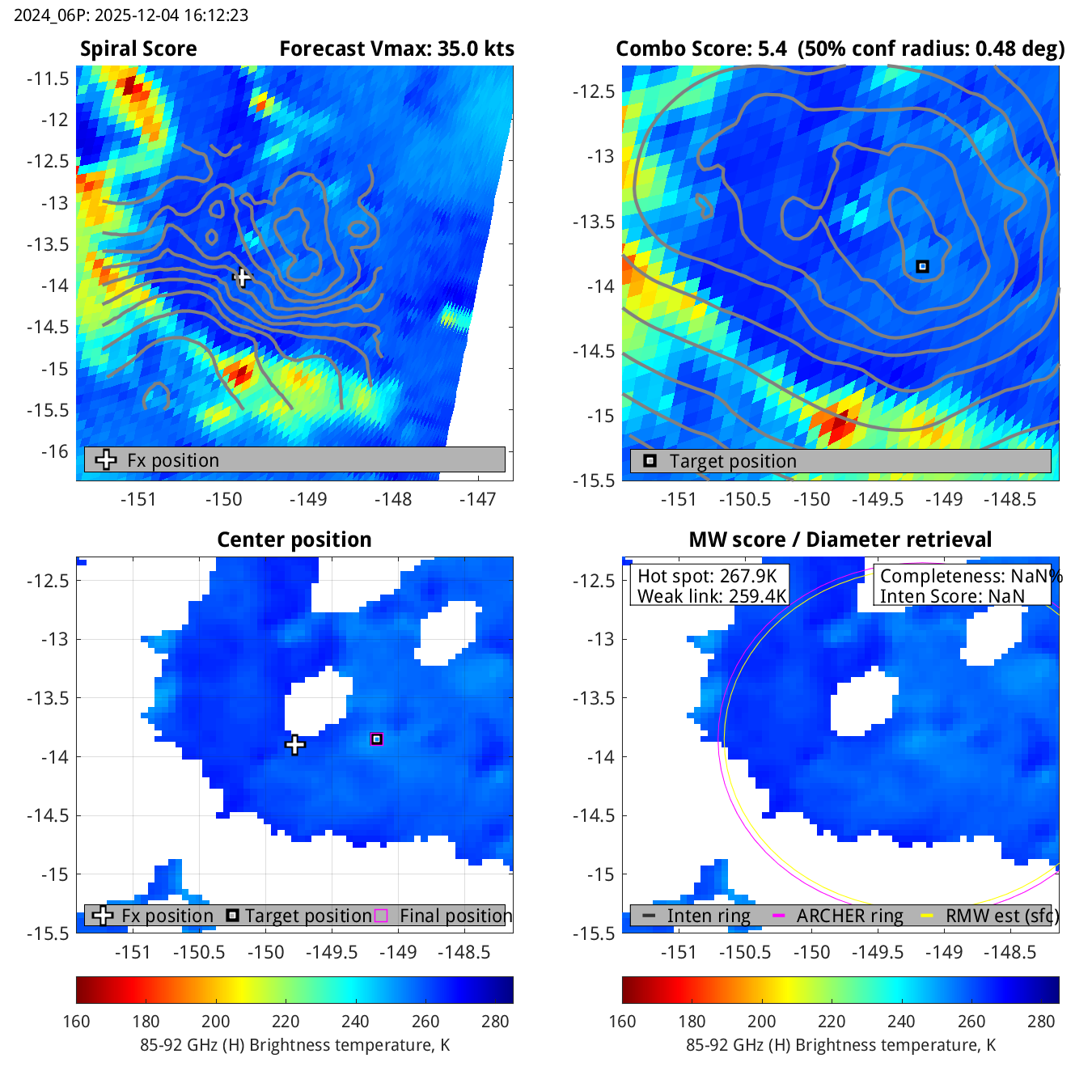
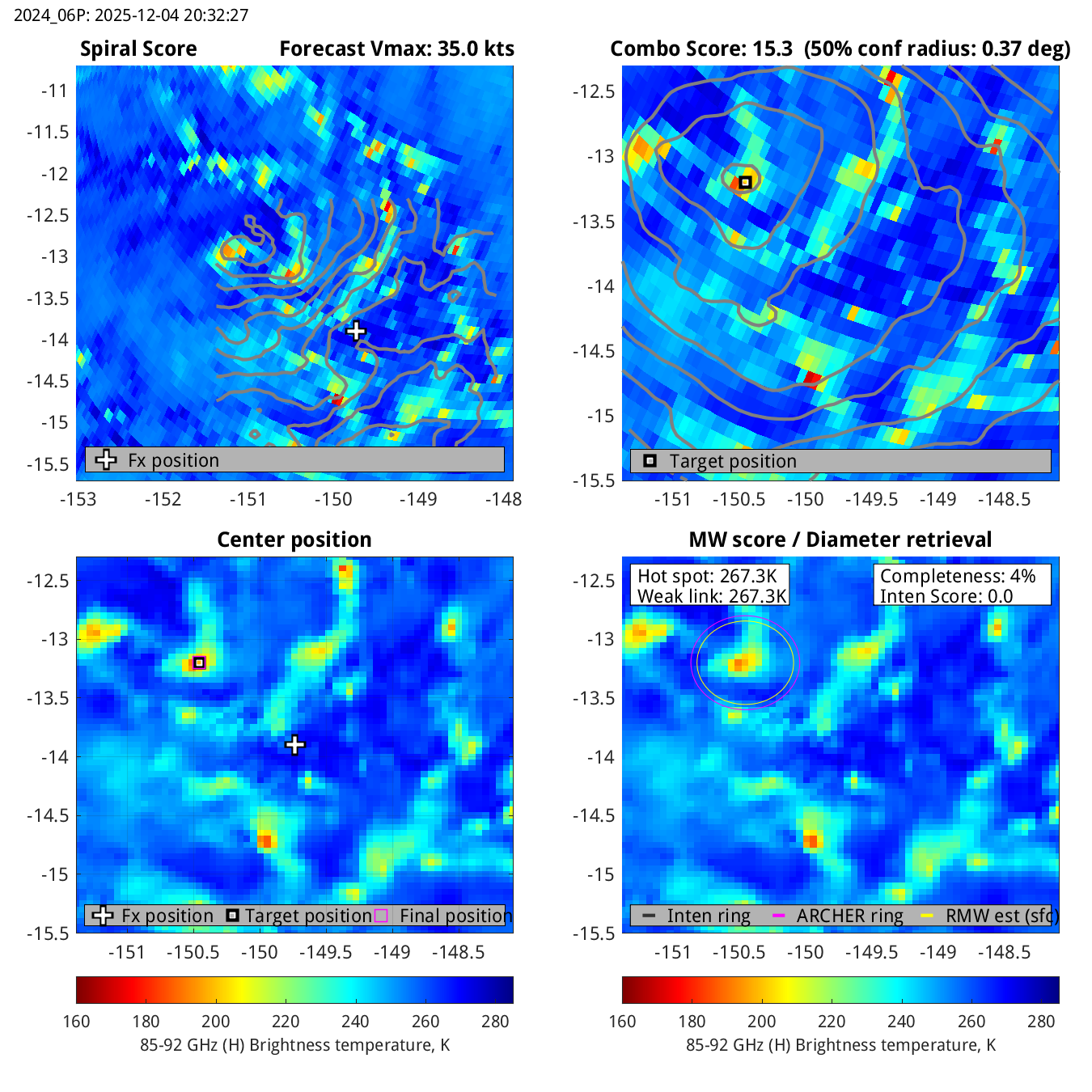
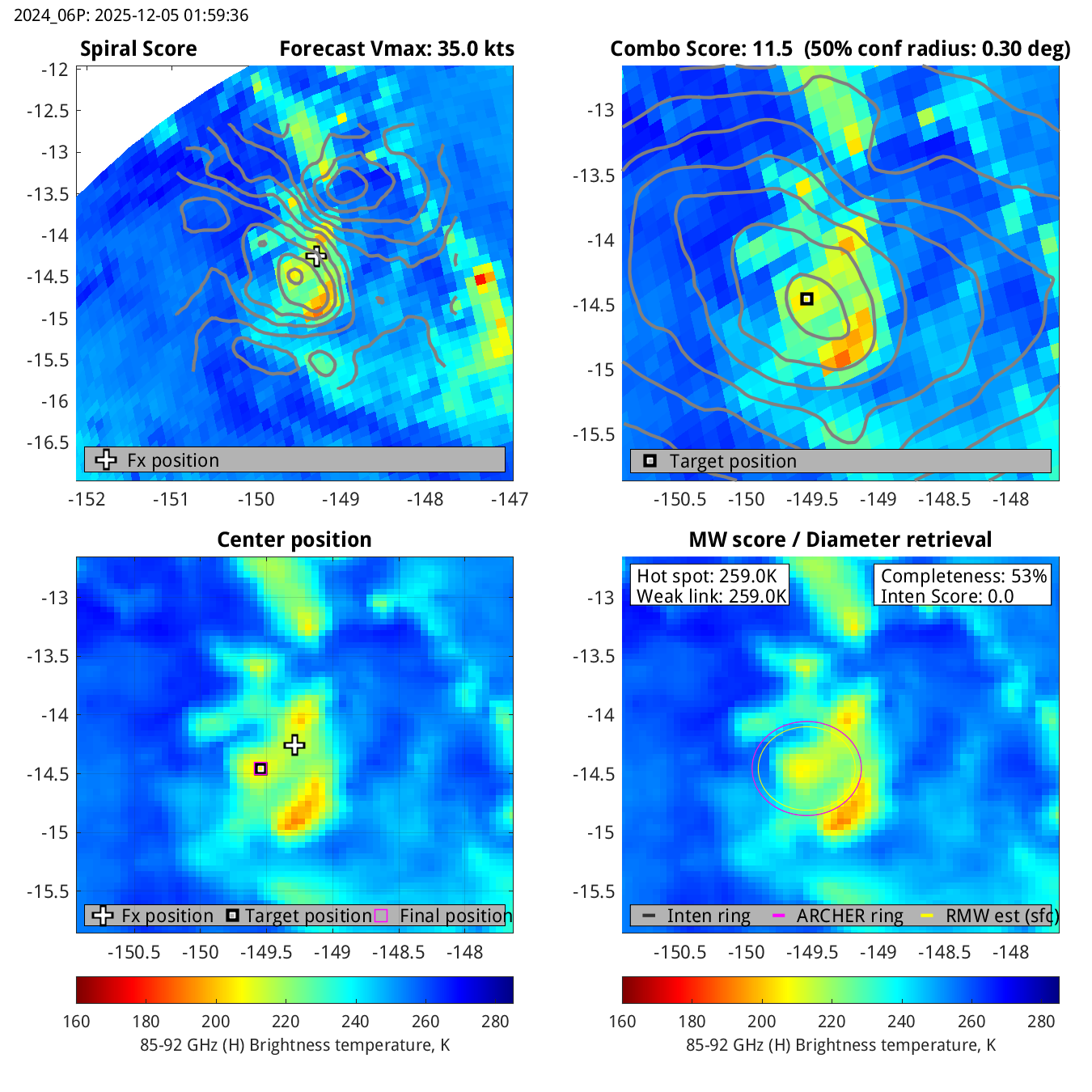
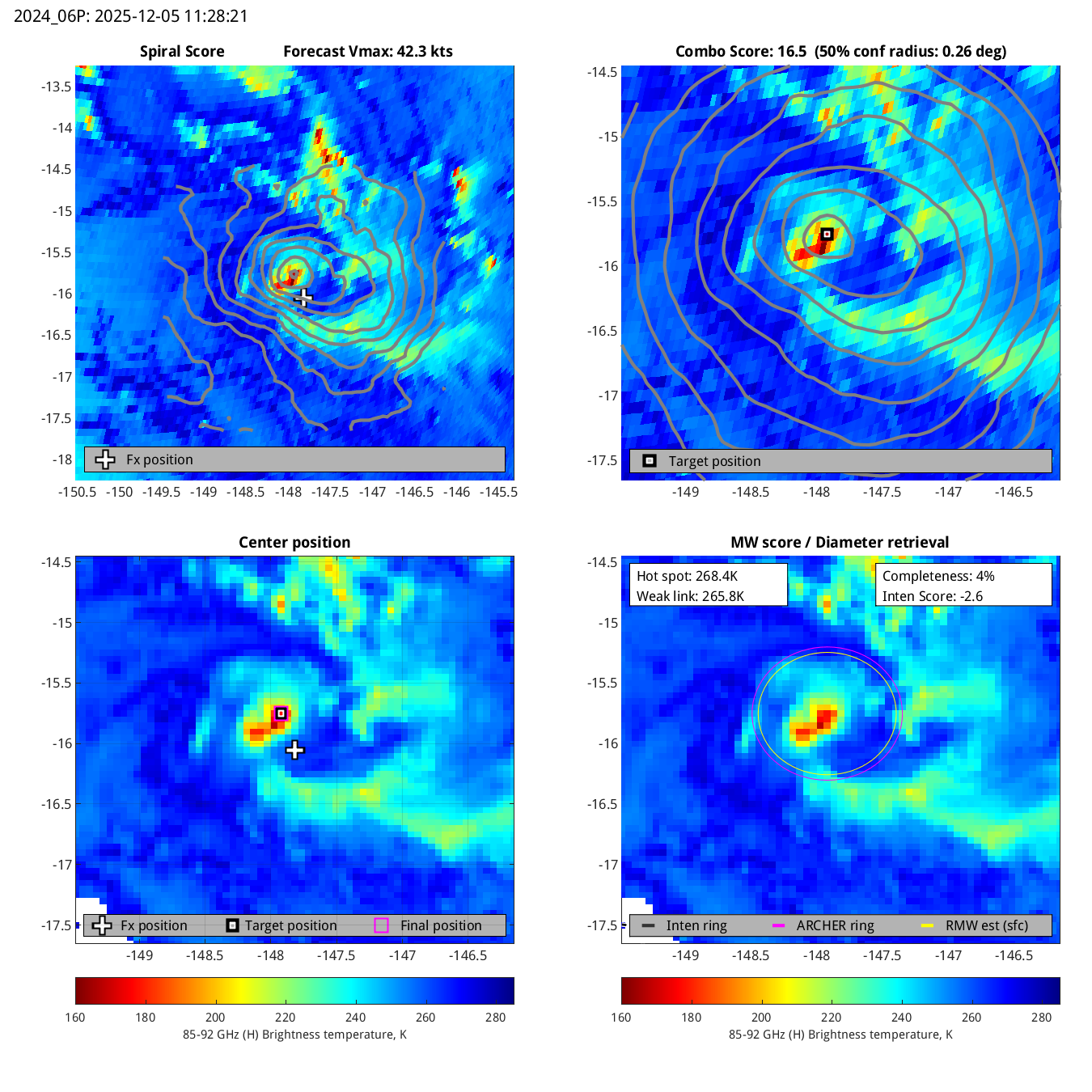
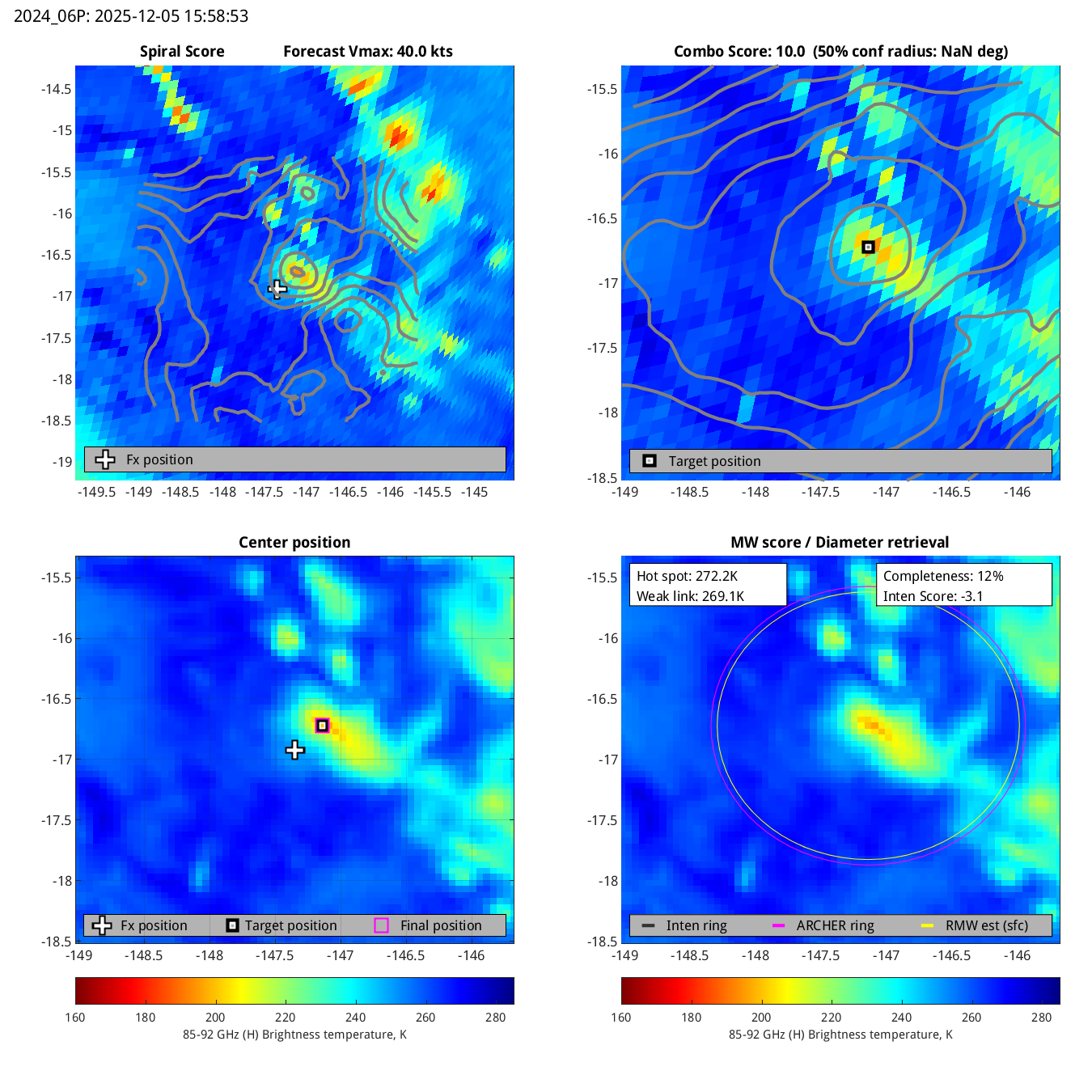
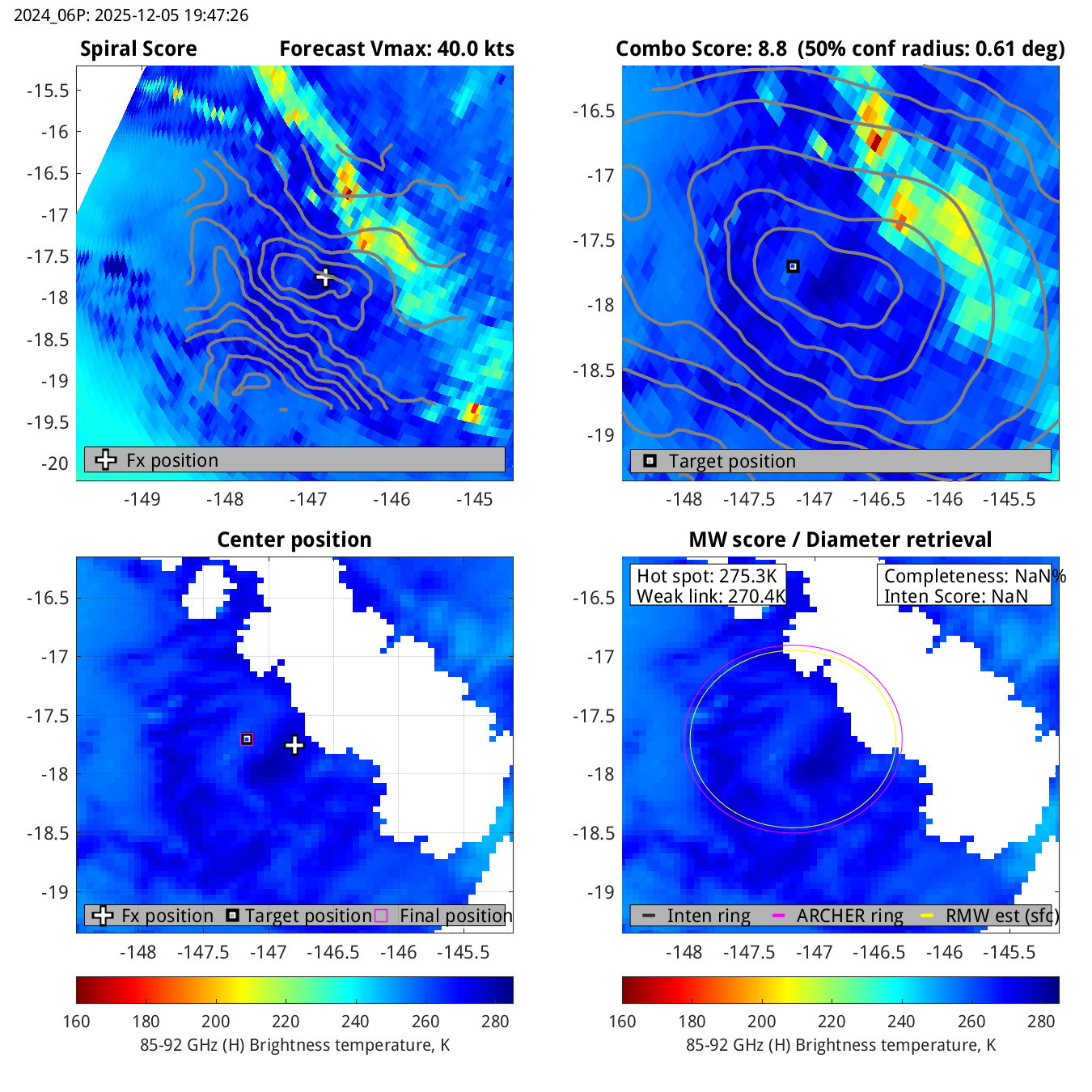
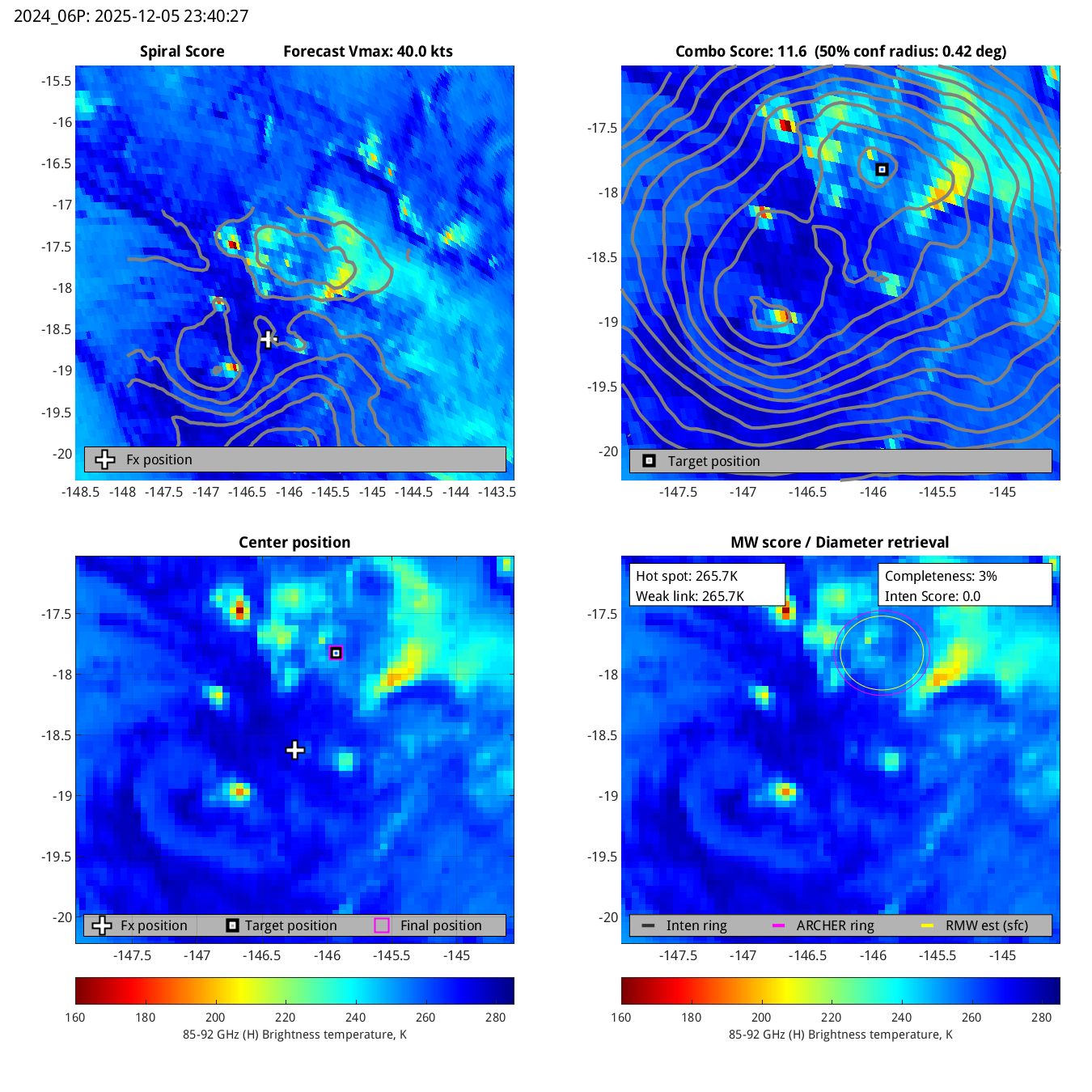
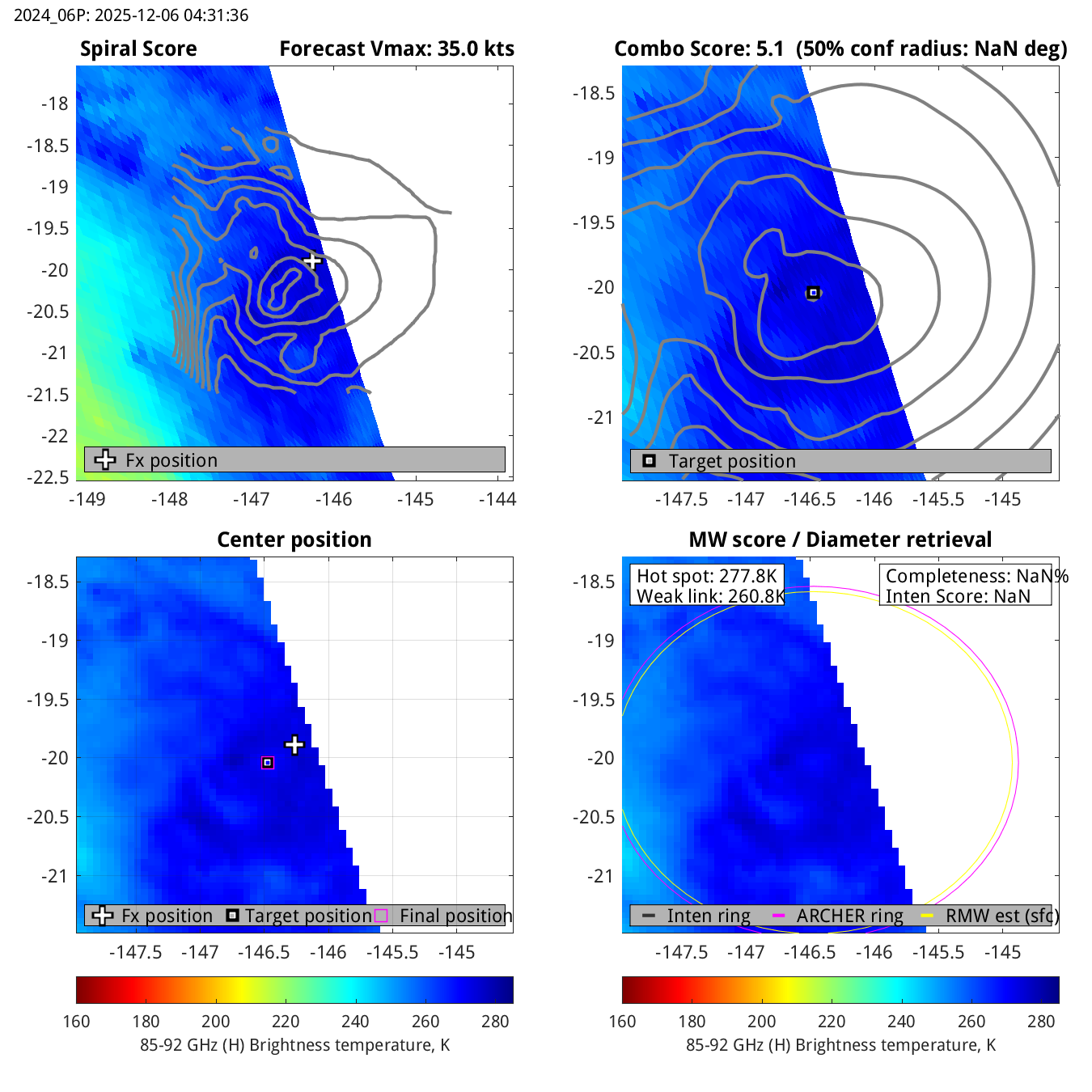
| Date/Time | Sat | MW Eye diam (km) | Est RMW (km) | Ring % | Tb diff (K) | Score | Meaning | JTWC estimate |
| 20251204T161223 | ssmis17_85 | 333.0 | 161.8 | NaN% | NaN | NaN | n/a | 35.0 kts |
| 20251204T203227 | gmi_85 | 88.8 | 39.5 | 4.1% | 0.0 | -0.0 | n/a | 35.0 kts |
| 20251205T015936 | ssmis18_85 | 88.8 | 39.5 | 53.4% | 0.0 | -0.0 | n/a | 36.7 kts |
| 20251205T112821 | amsr2_85 | 166.5 | 56.1 | 4.1% | 2.6 | -2.6 | n/a | 40.0 kts |
| 20251205T155853 | ssmis17_85 | 255.3 | 122.9 | 12.3% | 3.1 | -3.1 | n/a | 38.3 kts |
| 20251205T194726 | gmi_85 | 177.6 | 83.9 | NaN% | NaN | NaN | n/a | 36.8 kts |
| 20251205T234027 | amsr2_85 | 299.7 | 33.9 | 2.7% | 0.0 | -0.0 | n/a | 35.1 kts |
| 20251206T014535 | ssmis18_85 | 77.7 | 139.5 | NaN% | NaN | NaN | n/a | 35.0 kts |
| 20251206T043136 | ssmis17_85 | 333.0 | 161.8 | NaN% | NaN | NaN | n/a | 35.0 kts |
Key:
Diameter values indicate the estimated surface eyewall diameter (the MI eyewall edge diameter minus 10 km).
Diameter values are red if Ring % <= 65, yellow/brown if Ring % <= 85 and green if Ring % > 85.
"Ring %" is the percentage of the "ring" (eyewall inner boundary) that is 1) colder than the "hot spot" (warmest eye pixel) in the eye by 20K, or 2) the percentage that is a) colder than 232K and b) colder than the "hot spot" by 10K, whichever is greater.
"Tb diff" is the difference between the "hot spot" (warmest eye pixel) and the warmest pixel on the eyewall.
Scores are listed as negative, and not used, when the JTWC or NHC estimated Vmax is <50 kts in order to rule out weak but highly symmetric TCs.
Error messages in intensity scores: -920 is used when the hottest pixel in the eye is <200K, to prevent false positives; -909 is a failure to process (bad input data).